
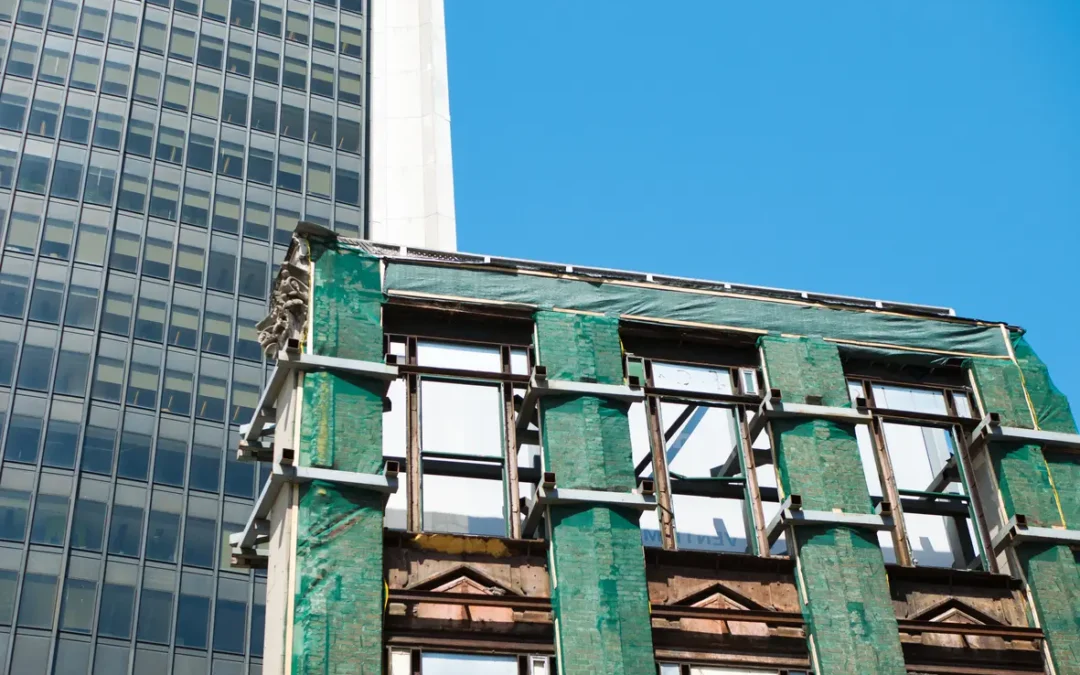
A commercial building does not have to be new to perform like one. In many cases, improving an existing property can make more practical and environmental sense than tearing it down and starting over.
That is why commercial building adaptive reuse, embodied carbon building considerations, and the question of retrofitting building envelope vs. new construction are becoming increasingly important for property owners and facility managers. Instead of treating an aging building as a liability, owners are taking a closer look at what can be preserved, improved, and put to work for another generation.
The building envelope is a major part of that equation. Commercial roofing systems, exterior walls, insulation, windows, waterproofing, and other exterior components all influence how well a commercial property handles weather, moisture, energy demands, and everyday wear.
Why Existing Buildings Are Getting a Second Look
Demolishing an older commercial property and replacing it with a new building can seem like the simplest way to address outdated performance. However, it also means discarding an existing structure along with the materials, energy, infrastructure, and resources already invested in it.
The U.S. Environmental Protection Agency recognizes preservation and adaptive reuse as strategies that can reduce the environmental impacts associated with new construction. Demolition and rebuilding require additional material production, transportation, construction activity, and waste management.
That does not mean every aging building should be preserved. Some properties have structural problems, outdated layouts, or functional limitations that make new construction the more practical option.
The important shift is to evaluate the existing building before assuming replacement is the answer.
What Makes the Building Envelope So Important?
The building envelope is the physical barrier separating a building’s interior from the outside environment. It includes the roof, exterior walls, windows, doors, insulation, waterproofing, flashing, and other components that protect the building from weather and help regulate interior conditions.
It also has a significant connection to energy performance. The U.S. Department of Energy notes that windows, walls, and roofs account for approximately 30% of primary energy consumption in commercial buildings.
When the envelope begins to deteriorate, the effects can extend beyond a single leak or damaged exterior component. Air leakage, inadequate insulation, moisture intrusion, and deteriorating roofing can contribute to comfort issues, higher operating costs, and additional maintenance demands.
That makes the envelope an important place to look when evaluating whether an existing commercial property can be improved rather than replaced.
Retrofitting Building Envelope vs. New Construction
The decision between a building envelope retrofit and new construction involves more than comparing the age of the property. Owners also need to consider the building’s condition, location, future use, operating costs, construction disruption, material requirements, and long-term value.
A retrofit can make sense when the existing structure remains fundamentally sound, and the building can meet future needs through targeted improvements.
| Existing Building Retrofit | New Construction |
| Preserves much of the existing structure | Starts with an entirely new structure |
| Can reduce demolition and construction waste | Requires new materials throughout the project |
| May allow work to happen in phases | Provides greater freedom in layout and design |
| Can improve envelope performance | Allows systems to be designed together from the beginning |
| May extend the useful life of the property | May address major structural or functional limitations |
| Preserves an established location | Creates an entirely new asset |
Neither approach is automatically right for every property. The better question is whether the existing building has enough useful life and adaptability to justify continued investment.
Embodied Carbon and the Case for Adaptive Reuse
Energy efficiency is only one part of a building’s environmental impact. Another important consideration is embodied carbon building emissions, which are associated with extracting raw materials, manufacturing products, transporting them, constructing the building, replacing components, and eventually disposing of them.
When an existing building is demolished, much of the carbon already invested in its structure is effectively discarded along with the building. Constructing a replacement then creates another demand for materials and construction activity.
This is where commercial building adaptive reuse becomes particularly relevant. Reusing an existing property can preserve portions of the structure while giving the building a new purpose, updated performance, or longer useful life.
An older office building, for example, may be renovated for healthcare, education, retail, or another commercial use. An industrial property may be adapted for a new tenant or different operational requirements.
The goal is not to preserve every component indefinitely. It is to determine which parts of the existing building still have value and where targeted improvements can make the property viable for the future.
Start With the Building You Have
Before deciding what to replace, property owners need a clear picture of what they already have. Maintenance records, inspection reports, utility bills, previous repairs, and recurring service calls can reveal patterns that are easy to miss when individual problems are handled separately. A roof that repeatedly needs repairs, for example, may point to a larger issue that deserves a broader evaluation.
This is where a condition assessment can become more valuable than another isolated repair. Understanding the current condition of the roof and other envelope components gives owners a basis for prioritizing improvements and planning future work.
Roofing is often a natural starting point because it is one of the building’s most exposed components and one of the primary defenses against water intrusion. Depending on its condition, the right solution could involve repair, restoration, coating, re-roofing, or replacement.
Delta Innovative Services provides commercial roofing systems, maintenance, repairs, restoration, re-roofing, and architectural sheet metal services for commercial and industrial properties. The goal is to match the approach to the property’s condition rather than automatically treating every aging roof as a replacement project.
Call Us to Evaluate Your Commercial Roofing
Think Beyond the Immediate Repair
One of the challenges with older commercial properties is that building problems are often addressed one at a time. A leak gets patched. A damaged wall gets repaired. A heating or cooling system gets replaced. A window gets upgraded. Each project may solve an immediate problem without addressing how the building’s systems work together.
A more strategic retrofit considers the envelope as a connected system. For example, improvements to roofing or insulation can affect heating and cooling demands. Better air sealing can influence interior comfort. Waterproofing improvements can help protect insulation and structural components from moisture-related deterioration.
Looking at improvements from a whole-building perspective rather than treating every upgrade as an isolated project. That approach can also help owners prioritize spending. Instead of reacting to the next failure, they can identify which improvements are most likely to protect the property and support its long-term use.
Retrofits Can Preserve More Than Materials
Environmental considerations are not the only reason owners are looking at retrofit strategies. An occupied commercial building has tenants, employees, equipment, customers, and daily operations to consider. A full demolition and rebuild can require significant relocation, downtime, and disruption before the new building is even ready.
Envelope improvements can sometimes be completed in phases, allowing owners to address priority areas while maintaining building operations. The exact approach depends on the property and scope of work, but phased construction can give owners more flexibility than starting over.
There is also value in preserving a building’s existing location. Commercial properties often sit where businesses already have established customers, transportation access, utilities, parking, and surrounding infrastructure.
When the building itself can be adapted to meet future needs, preserving that foundation can be part of the overall value proposition.
When New Construction Still Makes Sense
The case for retrofitting should not become an argument against new construction. Some buildings have reached a point where repairs and upgrades cannot provide the functionality or performance the property requires. Significant structural deterioration, major code challenges, inadequate capacity, or an incompatible layout can all make replacement worth considering.
New construction can also provide greater flexibility when an owner needs a fundamentally different building. Starting from the ground up allows the design team to integrate structure, envelope, mechanical systems, lighting, and other components from the beginning.
The key is making that decision after evaluating the existing asset. A building should not automatically be demolished because it is old, just as it should not automatically be preserved because it exists. The right decision comes from understanding its condition, future potential, and the investment required to get it there.
The Greenest Square Foot May Already Be Standing
Commercial sustainability is increasingly becoming a question of what can be preserved, improved, and reused rather than simply what can be built next.
A well-planned building envelope retrofit can extend the useful life of an existing property, improve protection and performance, address recurring maintenance issues, and potentially avoid some of the material and environmental costs associated with demolition and new construction.
For commercial property owners, the first step does not have to be deciding whether to tear down or rebuild. It can be taking a closer look at what the existing building can still do. Before you rebuild, evaluate what you can restore.
Schedule a Commercial Inspection Today
Frequently Asked Questions
What Is A Commercial Building Envelope Retrofit?
A commercial building envelope retrofit involves improving existing exterior components to address issues involving durability, moisture, energy performance, or occupant comfort. Depending on the property, the work may include roofing, insulation, windows, exterior walls, waterproofing, flashing, and related systems.
How Does Adaptive Reuse Reduce Environmental Impact?
Commercial building adaptive reuse can preserve portions of an existing structure instead of demolishing them and constructing an entirely new building. This can reduce demand for new materials and avoid some emissions associated with demolition, manufacturing, transportation, and construction.
Is Retrofitting A Building Envelope Better Than New Construction?
There is no universal answer. Retrofitting can make sense when an existing building is structurally sound and capable of meeting future needs through targeted improvements, while new construction may be appropriate when a property has significant structural, functional, or capacity limitations.
Can A Commercial Roof Be Restored Instead Of Replaced?
In some cases, yes. The appropriate solution depends on the roof’s age, condition, existing system, moisture levels, and other factors. A professional assessment can help determine whether repair, restoration, re-roofing, or replacement is the appropriate approach.